Organic Mixed Conductors
How do ions control charged states in organic mixed conductors?
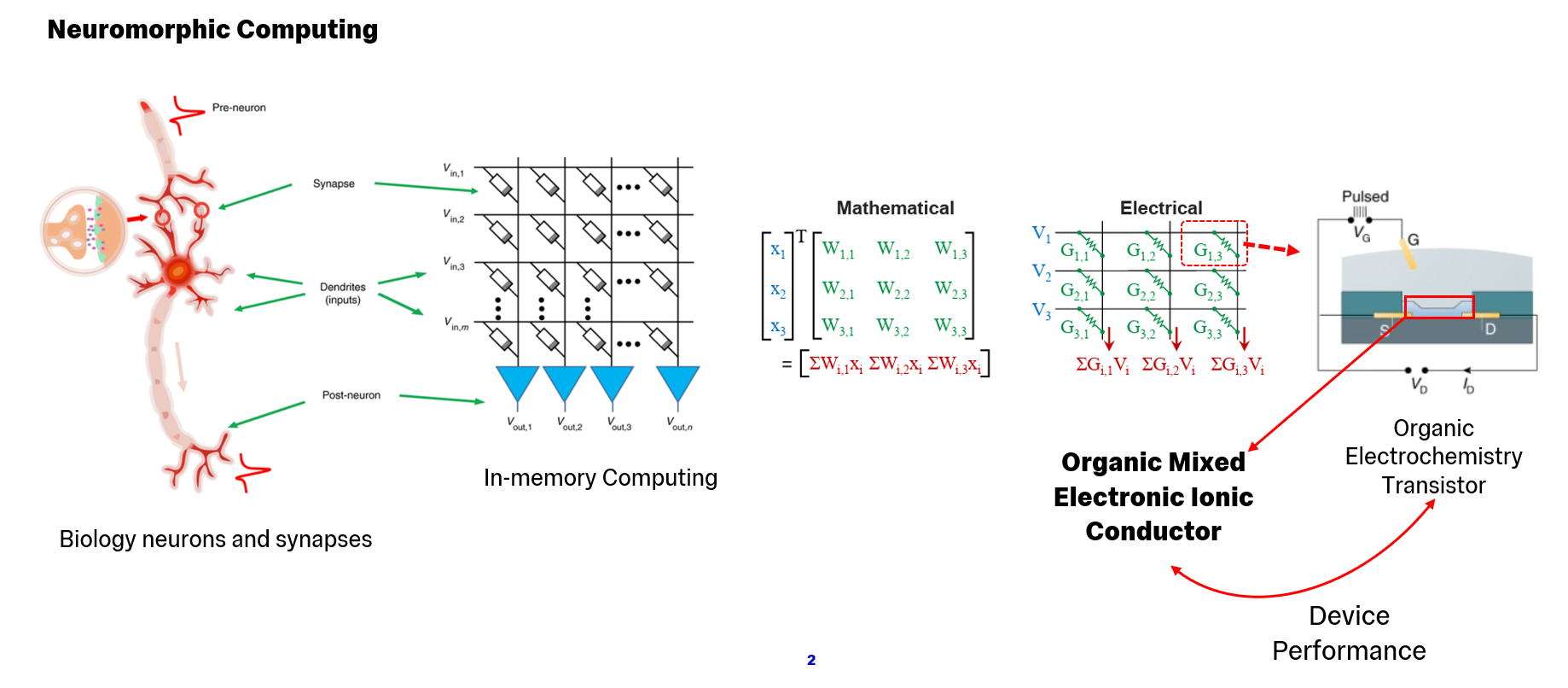
Organic mixed ionic-electronic conductors are soft electronic materials that can transport both electronic charges and ions. This makes them useful for low-power bioelectronic and neuromorphic devices, where electronic conductance can be controlled by ion injection, charge compensation, and local electrochemical doping. [1,2]
Our research focuses on three connected questions:
- How do polarons form?
- How are polarons stabilised in devices?
How can we observe these processes during operation?
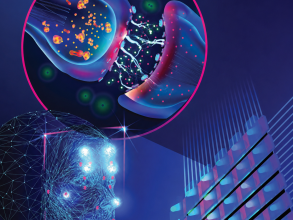
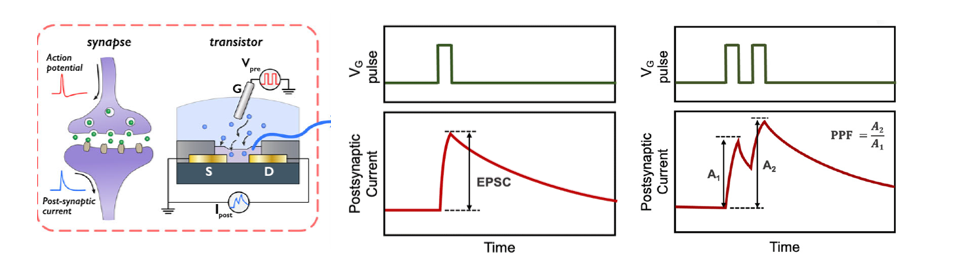
We develop organic synaptic transistors based on molecular semiconductors and mixed ionic-electronic conductors. In these devices, ions enter or interact with the polymer channel and change its electronic conductance. This allows the device to show short- and long-term synaptic plasticity, similar to memory and learning functions in biological systems. [3,4]
A central challenge is to understand what microscopic state stores the conductance change. In many organic mixed conductors, this involves the formation of charged molecular states called polarons. Their formation, localisation, and stability depend strongly on molecular structure, side-chain chemistry, backbone design, ion distribution, and thin-film morphology.
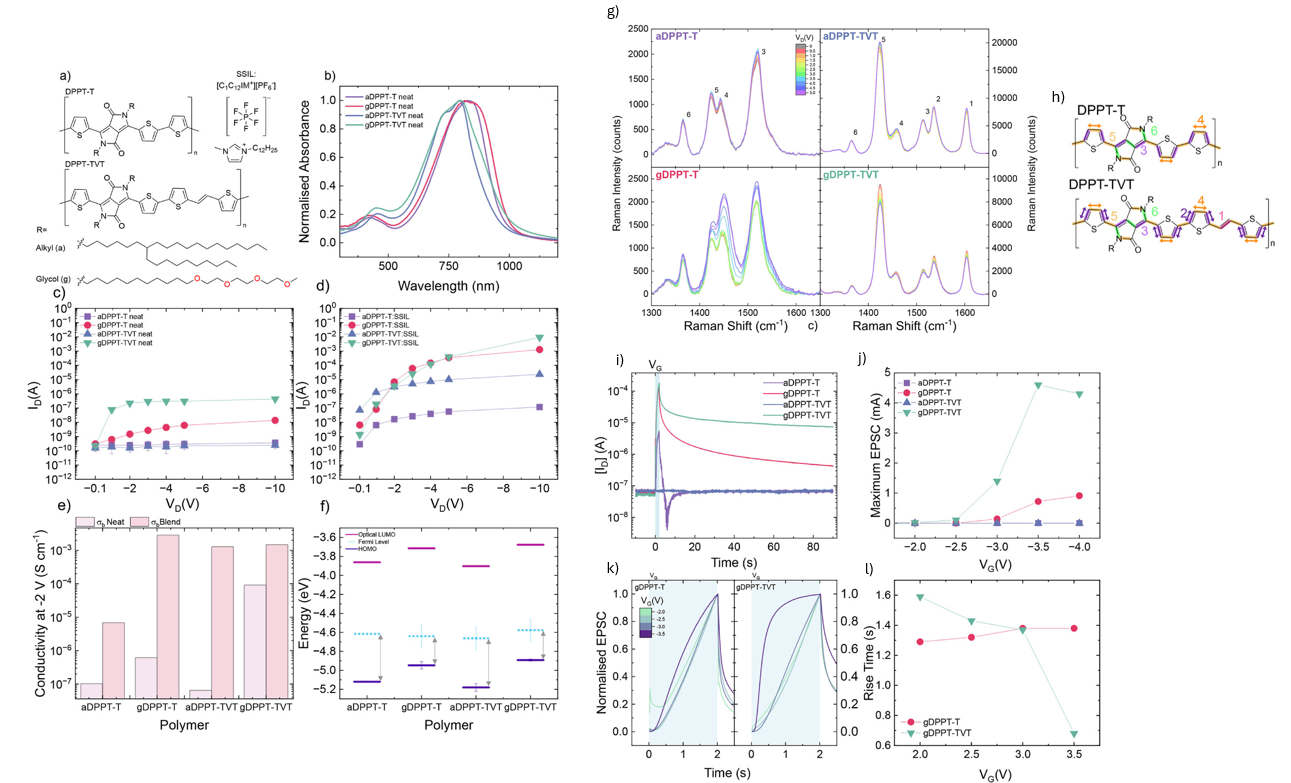
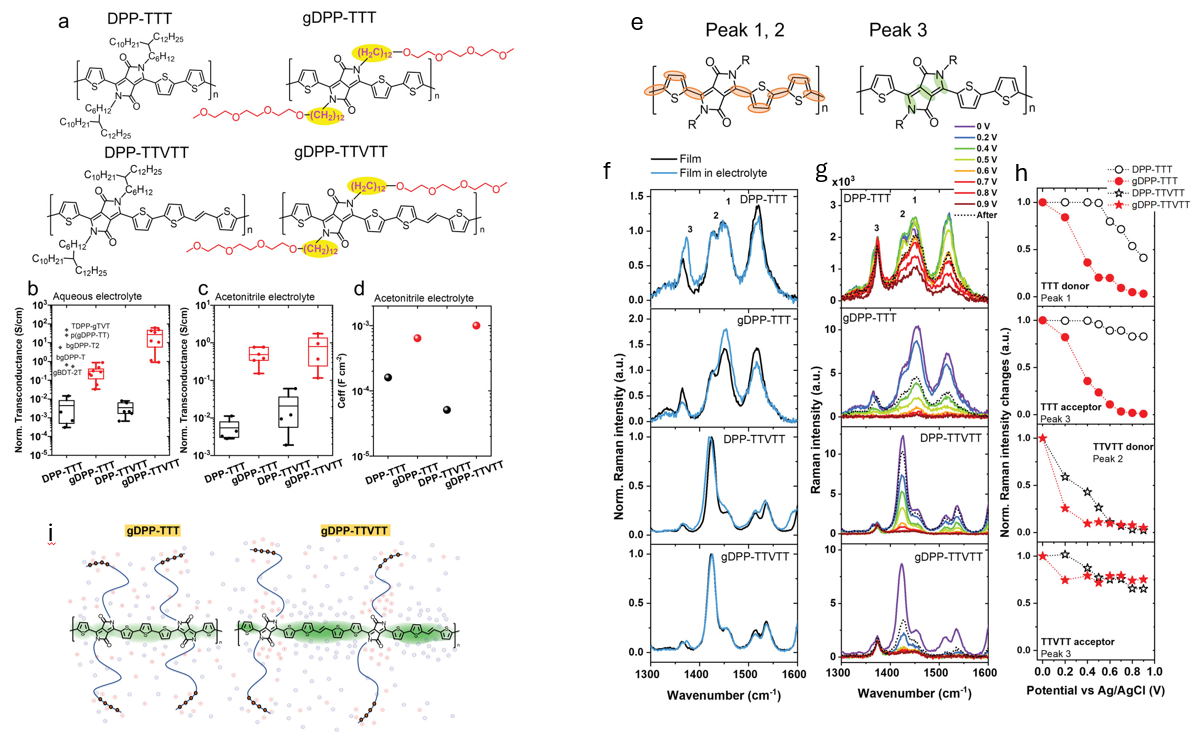
Recent work from the group has shown that glycol side chains, alkyl spacers, and elongated conjugated backbones can strongly influence polaron formation, charge transport, and ion-mediated doping dynamics in DPP-based polymers. These studies provide molecular design rules for developing higher-performance organic mixed conductors and synaptic transistor materials. [3,5,6]
We combine device fabrication, three-terminal electrical characterisation, in situ electric-field-dependent vibrational spectroscopy, and molecular modelling to track how ions and electronic charges interact during device operation. Particular attention is given to polaron formation, ion migration, relaxation dynamics, retention, operational stability, and the molecular origins of synaptic behaviour.
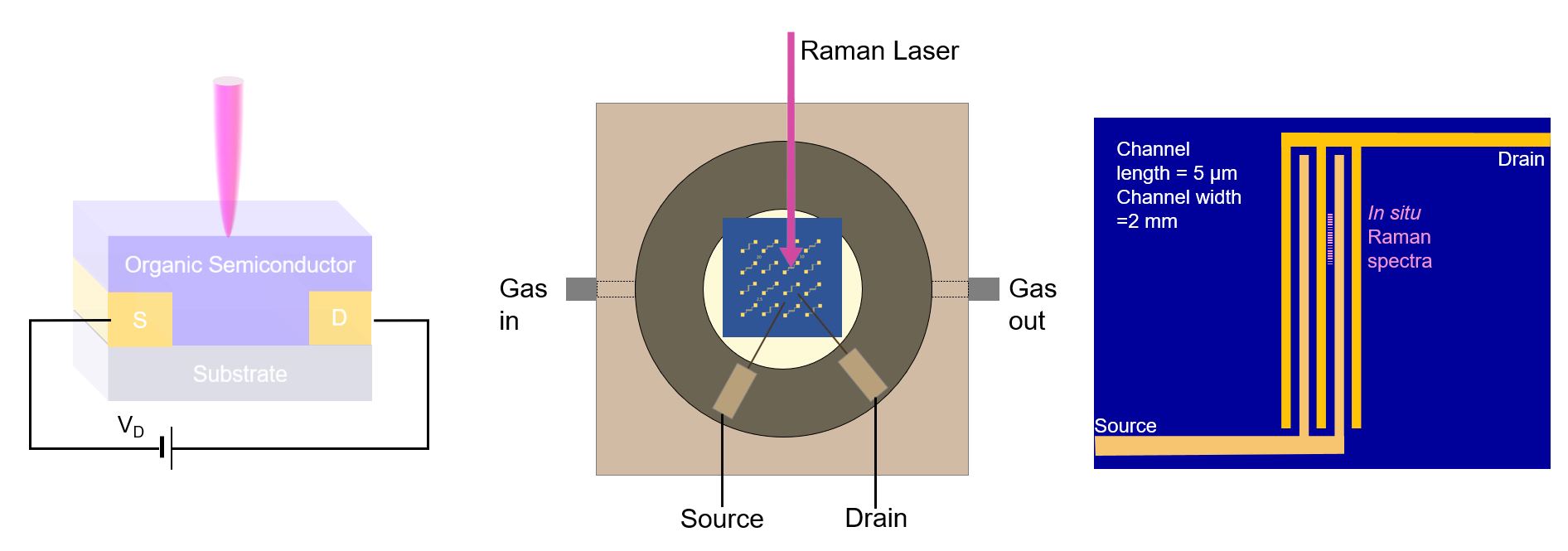
In situ and operando measurements are essential because electrical measurements alone cannot fully identify the microscopic processes inside the polymer channel. By combining transistor measurements with vibrational spectroscopy, we aim to distinguish ion motion, electrochemical doping, polaron formation, and structural relaxation during operation.
Through this research, we aim to establish all-solid-state organic synaptic transistors as platform devices for low-power neuromorphic circuits. At the same time, we address fundamental questions in mixed ionic-electronic transport, electrochemical doping, and memory formation in soft electronic materials.
This research direction focuses on all-solid-state organic synaptic transistors, synaptic plasticity, polaron stabilisation, and molecular-level ion-electron interactions.
Example Projects:
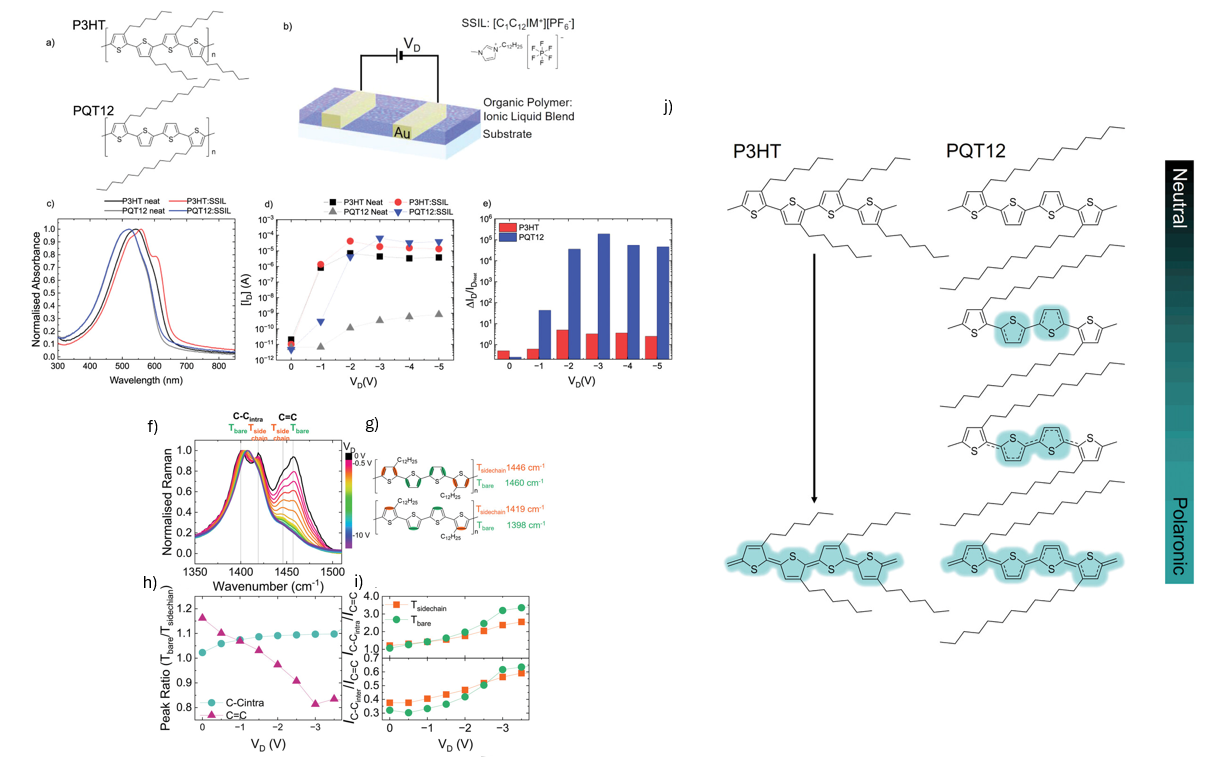
- Backbone-Dependent Excited-State and Polaron Pair Formation in Thiophene-Based Polymers
- Glycol Side-Chain Engineering for Balanced Ionic and Electronic Transport in DPP Copolymers
- Backbone Planarity, Glycolation, and Polaron Delocalisation in DPP-Based Mixed Conductors
- Molecular Origins of Ion-Mediated Conductance States in Organic Synaptic Transistors
- Solid-State Ionic Liquid Doping of P3HT for Polaron-Mediated Molecular Sensing
- Operando Raman Probes of PEDOT:PSS OECTs for Metabolite Sensing and Low-Noise Bioelectronics
References
1. Tan, E.; Kim, J.; Stewart, K.; Pitsalidis, C.; Kwon, S.; Siemons, N.; Kim, J.; Jiang, Y.; Frost, J. M.; Pearce, D.; Tyrrell, J. E.; Nelson, J.; Owens, R. M.; Kim, Y.-H.; Kim, J.-S. The Role of Long-Alkyl-Group Spacers in Glycolated Copolymers for High-Performance Organic Electrochemical Transistors. Advanced Materials 2022, 34, 2202574. DOI: 10.1002/adma.202202574.
2. Stewart, K.; Pagano, K.; Tan, E.; Daboczi, M.; Rimmele, M.; Luke, J.; Eslava, S.; Kim, J.-S. Understanding Effects of Alkyl Side-Chain Density on Polaron Formation Via Electrochemical Doping in Thiophene Polymers. Advanced Materials 2024, 36, 2211184. DOI: 10.1002/adma.202211184.
3. Stewart, K.; Tan, E.; Kim, J.; Kim, Y.-H.; Kim, J.-S. Polarons in DPP Polymers: How Glycol Side Chains and Elongated Conjugated Backbone Influence the Formation and Transport. Advanced Electronic Materials 2026, 12, e2500731. DOI: 10.1002/aelm.202500731.