
Organic Fundamentals and Charge Dynamics
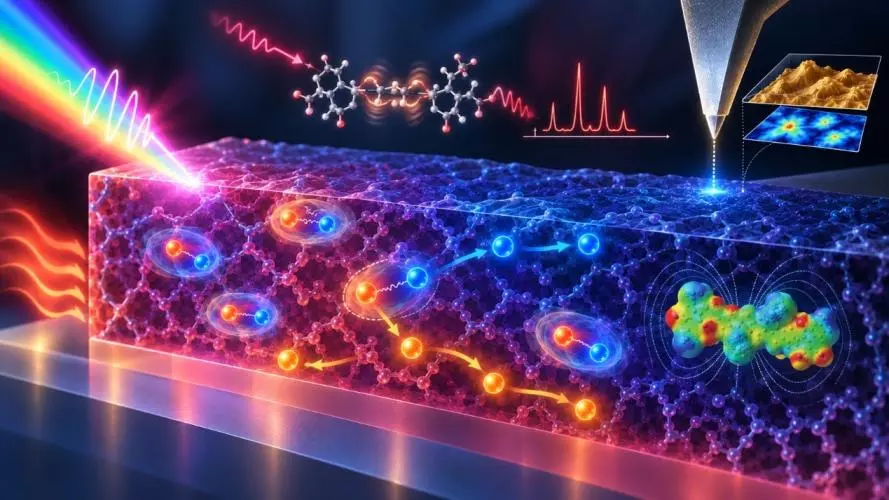
How do molecular structure, morphology and interfacial energetics control charged and excited states in organic and hybrid semiconductors?
We investigate the fundamental physical processes that govern organic semiconductors and organic/inorganic hybrid materials, including excitons, polarons, charge formation, trapping, transport and recombination. This research provides the understanding needed to connect molecular structure with optoelectronic and electrochemical device behaviour.
Our work asks how chemical design, molecular packing, molecular electrostatics, side-chain chemistry and vibrational relaxation shape the formation, localisation, transport, recombination and stability of charged and excited states.
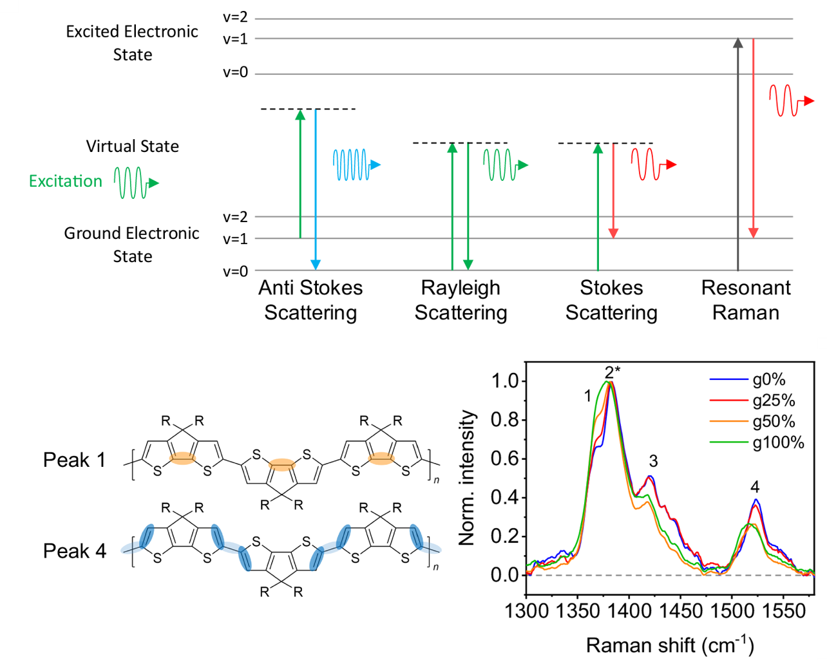
To uncover the molecular origins of these characteristics, our group combines a range of optical and electrical characterization techniques. Raman spectroscopy probes molecular vibrations through inelastic light scattering, with spectral shifts in vibrational frequencies and changes in their intensities providing molecular fingerprints of specific bonding, backbone conformation and π-electron distribution. Temperature-dependent Raman measurements further allow us to track structural changes under thermal stress associated with thermal stability and degradation. Further, we actively employ photoluminescence (PL) measurement, providing radiative decay of photoexcited states, for insight into energetics and recombination process.
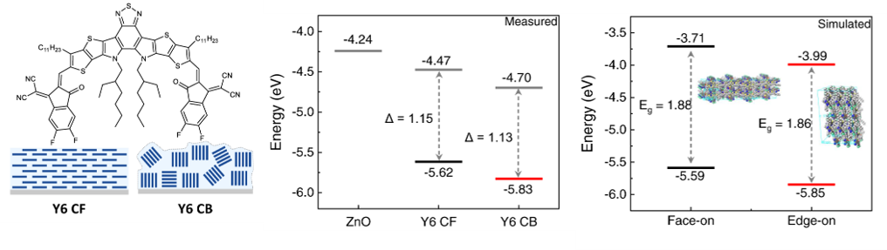
The energetics of organic semiconductors, including their HOMO/LUMO levels and Fermi levels, govern charge generation, transfer and transport across molecular and material interfaces. Ambient photoemission spectroscopy (APS) provides a direct and effective way to characterize these electronic energy levels under ambient conditions. A comprehensive picture of energetics can be obtained by combining APS measurements of occupied electronic states with Kelvin-probe based work function measurement, which provides fermi levels of material. We investigate how molecular structure and orientation modify materials' energetics and ultimately, charge generation and transport.
Beyond these techniques, we also employ a broad usage of optoelectronic and nanoscale characterization tools to build a multiscale picture linking molecular properties to charge dynamics and also device performance.
Current Areas of Research
- Charged and Excited States in Organic Semiconductors: how excitons, charge-transfer states, polarons and polaron pairs form, relax and persist in conjugated molecular materials.
- Electron-Phonon Coupling and Structural Relaxation: how molecular vibrations and reorganisation energy control ultrafast excited-state evolution and charge localisation.
- Molecular Electrostatics and Energetic Landscapes: how quadrupole moments, molecular orientation and intermolecular interactions shift energy levels, induce band bending and influence charge generation and recombination.
- Interfacial Charge Dynamics in Hybrid Materials: how organic interlayers, transport layers and perovskite interfaces create charge-transfer complexes, interfacial recombination losses and light-induced energetic changes.
- Molecular Origins of Stability: To connect molecular structure, photochemical degradation pathways and morphological stability to the long-term behaviour of organic and hybrid optoelectronic materials.
Example Projects
- Molecular electrostatics and orientation-controlled energetic shifts in non-fullerene acceptors
- Ultrafast vibrational relaxation and formation of excitons, polaron pairs and trapped charges
- Molecular origins of photostability and degradation in organic photovoltaic materials
- Interfacial charge-transfer complexes and light-soaking in perovskite solar cells
- Operando Raman, surface photovoltage and photoemission spectroscopy of charge formation and relaxation
Related Publications
[1] Luke, J.; Yang, E. J.; Labanti, C.; Park, S. Y.; Kim, J.-S. Key Molecular Perspectives for High Stability in Organic Photovoltaics. Nature Reviews Materials 2023, 8, 839-852. DOI: 10.1038/s41578-023-00606-5.
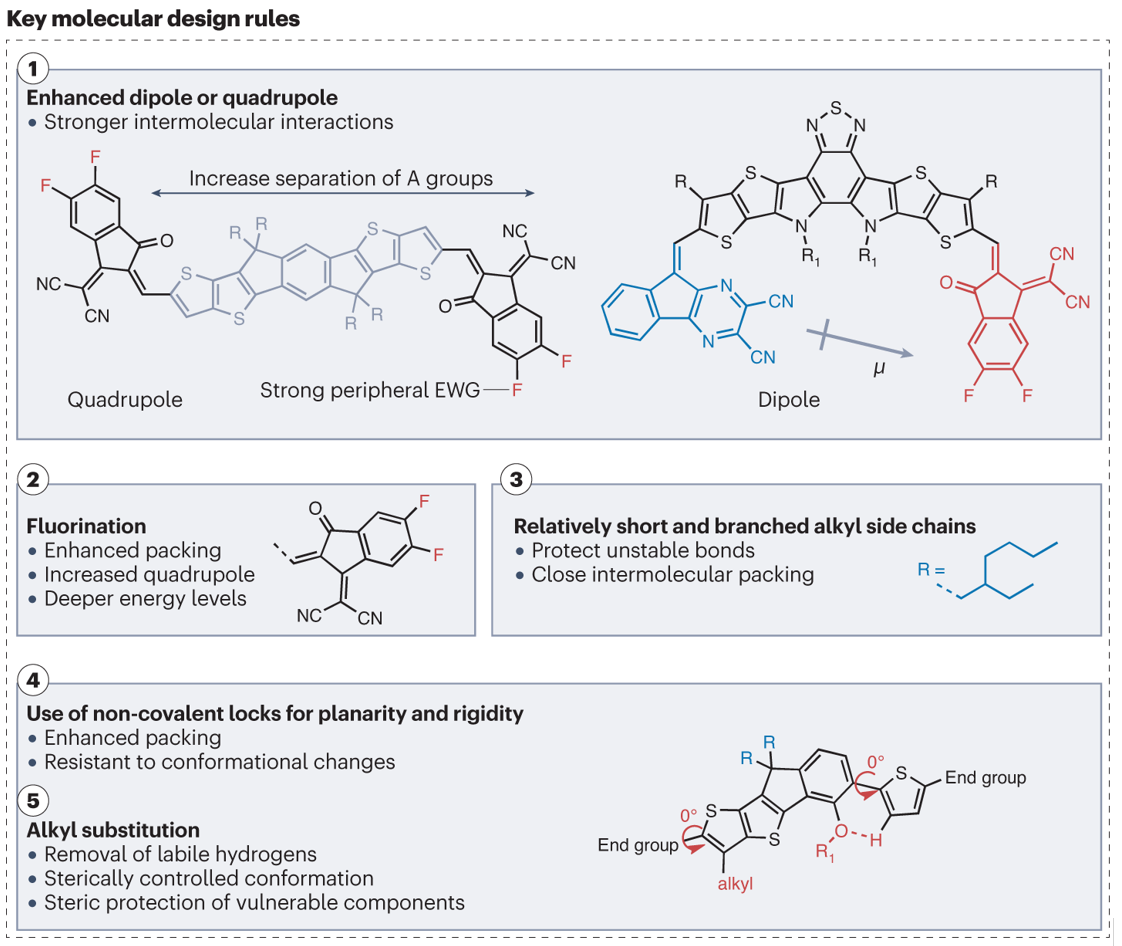
Molecular design toward optimized electrostatics, side chains, and conformational rigidity enables stable molecular packing and improved OPV stability
[2] Luke, J.; Yang, E. J.; Chin, Y.-C.; Che, Y.; Winkler, L.; Whatling, D.; Labanti, C.; Park, S. Y.; Kim, J.-S. Strong Intermolecular Interactions Induced by High Quadrupole Moments Enable Excellent Photostability of Non-Fullerene Acceptors for Organic Photovoltaics. Advanced Energy Materials 2022, 12, 2201267. DOI: 10.1002/aenm.202201267.
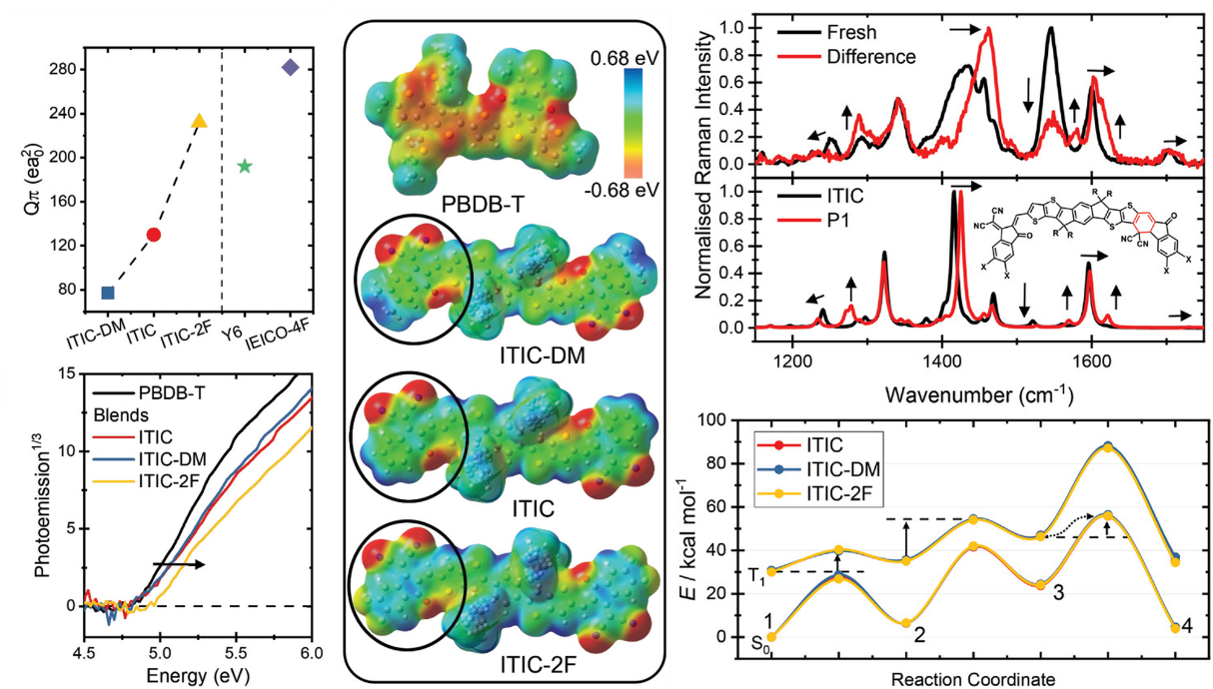
High quadrupole moments enhance intermolecular interactions, leading to improved photochemical and morphological stability of NFAs.
[3] Pagano, K.; Kim, J. G.; Luke, J.; Tan, E.; Stewart, K.; Sazanovich, I. V.; Karras, G.; Gonev, H. I.; Marsh, A. V.; Kim, N. Y.; Kwon, S.; Kim, Y. Y.; Alonso, M. I.; Dörling, B.; Campoy-Quiles, M.; Parker, A. W.; Clarke, T. M.; Kim, Y.-H.; Kim, J.-S. Slow Vibrational Relaxation Drives Ultrafast Formation of Photoexcited Polaron Pair States in Glycolated Conjugated Polymers. Nature Communications 2024, 15, 6153. DOI: 10.1038/s41467-024-50530-7.
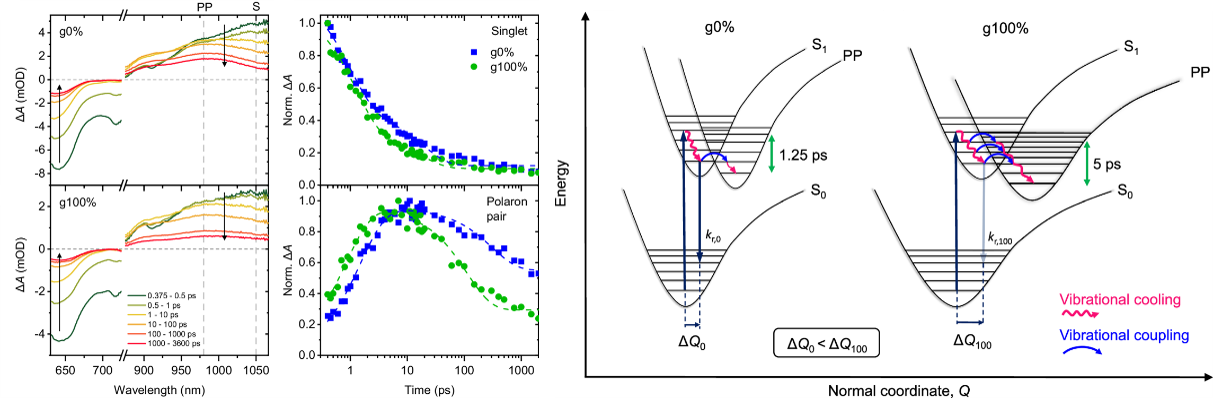
Gylcolation slows structural relaxation, promoting ultrafast polaron-pair formation through stronger vibrational coupling
[4] Fu, Y.; Lee, T. H.; Chin, Y.-C.; Pacalaj, R. A.; Labanti, C.; Park, S. Y.; Dong, Y.; Cho, H. W.; Kim, J. Y.; Minami, D.; Durrant, J. R.; Kim, J.-S. Molecular Orientation-Dependent Energetic Shifts in Solution-Processed Non-Fullerene Acceptors and Their Impact on Organic Photovoltaic Performance. Nature Communications 2023, 14, 1870. DOI: 10.1038/s41467-023-37234-0.