
Prof. Ji-Seon Kim
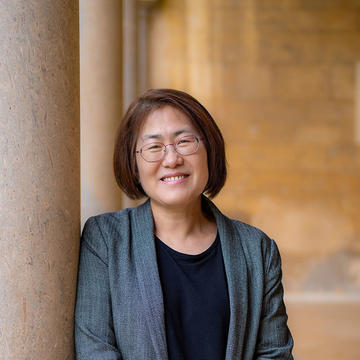
Professor of Electronic Materials
Department of Chemistry, University of Oxford
ji-seon.kim@chem.ox.ac.uk
Bio: Ji-Seon Kim is Professor of Electronic Materials in the Department of Chemistry at the University of Oxford, as part of the Sustainable Chemistry and Materials Initiative. She joined Oxford after serving as Professor of Solid State Physics in the Department of Physics at Imperial College London, where she also served as Director of the EPSRC Plastic Electronics Centre for Doctoral Training and Director of the MRes in Soft Electronic Materials. She also held a Specially Appointed Professorship at Tokyo Institute of Technology (Japan), and a WCU Professorship at KAIST (South Korea). She has previously taken up an EPSRC Advanced Research Fellowship at the University of Cambridge, obtained a PhD in Physics in 2000 under the supervision of Prof. Sir Richard Friend.
Kim's group research primarily focuses on sustainable molecular semiconductors, expanding into new classes of electronic materials such as mixed electronic/ionic conductors and organic/inorganic hybrids. Molecular semiconductors—including conjugated small molecules and polymers—combine the semiconducting properties traditionally associated with inorganic materials with the advantages of soft materials, such as low-temperature processability, scalability over large areas, and relatively low-cost fabrication. These materials have diverse optoelectronic applications, ranging from displays and lighting to flexible thin-film electronics, solar energy conversion, and biosensing. Her group investigates fundamental scientific questions related to the use of these materials in novel optoelectronic devices such as solar cells, photoconversion sensors, synaptic transistors, biosensors, and displays. Her research also includes the development of advanced nanometrology techniques tailored for these materials. This involves non-invasive structural analysis (e.g., steady-state and transient vibrational spectroscopy) and energetics studies (e.g., Kelvin probe, photoemission, and surface photovoltage spectroscopy). These experimental approaches are complemented by molecular density functional theory (DFT) simulations to gain a deeper understanding of the molecular origins and structural dynamics that influence device functionality and performance. Professor Kim works closely with several industrial partners, including Samsung Electronics (Korea), Oninn (Brazil), and the National Physical Laboratory (UK).
Examples of current research projects:
- Molecular Semiconductors for Sustainable Clean Energy Generation
- Probing and Manipulating Polarons in Molecular Semiconductors
- Mixed Electronic-Ionic Materials Towards Low-Powered Sustainable Healthcare Applications
- Energetic and Kinetic Analysis of Electronic Materials for Solar Driven Photoconversion
- Interface Engineering for High Performance Energy Storage Applications
Professor Kim has been elected a Fellow of the Institute of Physics (2023) and a Fellow of the Royal Society of Chemistry (2022). She currently serves as a member of the UK EPSRC Strategic Advisory Team (2020–2026) and is part of the EPSRC Physical Sciences Skills Focus Group. Additional leadership roles include Chair of Examiners for the EPSRC Sensors CDT at the University of Cambridge (2021–2024) and Advisory Board Member for the Coated2/M2A EngD programme at Swansea University (2017–2022). She also serves as an Editorial Advisory Board Member for Applied Physics Letters (since 2020), Associate Editor for Organic Electronics (since 2020), International Advisory Board Member for Advanced Electronic Materials (since 2022), and Editorial Board Member for Aggregate (since 2024).