
Advanced Spectroscopy
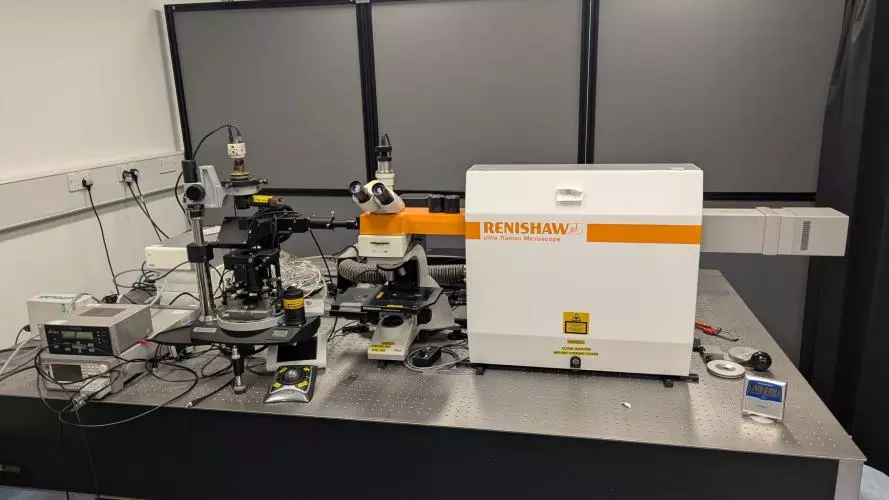
Raman Spectroscopy
Raman spectroscopy is a vibrational spectroscopy based on a molecule's polarisability. Raman spectroscopy relies on the inelastic scattering of light via a virtual excited state, leaving a molecule in an excited vibrational state. Using Raman spectroscopy we can probe the chemical structure, molecular conformation and molecular orientation of a sample. We can also use it to probe the nature of different excited states in a material.
Measurement Types:
- 5 laser excitation wavelengths (457 - 785 nm)
- Resonant and non-resonant excitation
- Angle dependent polarisation control
- Confocal fluorescence
- Surface Enhanced Raman Spectroscopy (SERS)
- Tip Enhanced Raman Spectroscopy (TERS)
- In Situ Pressure Dependent Raman Spectroscopy
- In Situ Temperature Dependent Raman Spectroscopy (77 - 600 K)
- In Situ Device Operation
- In Situ Cyclic Voltammetry
- In Situ Electrochemical Degradation
- UV-Excitation Source
Applications in our research
Degree of Molecular Order
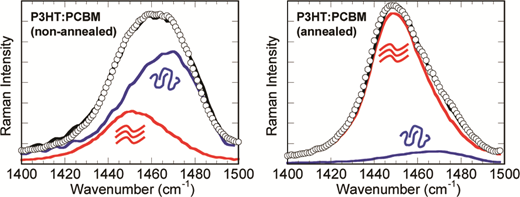
Ordering of molecules in semiconducting materials can have significant effects on their optoelectronic properties. For example, thin films of regioregular poly(3-hexylthiophene) (RR-P3HT) can exhibit a high degree of molecular order (π–π stacking of molecules). This high degree of molecular order can lead to an increase in absorption at longer wavelength and a dramatic increase in charge carrier mobility as compared to its disordered form. Understanding of this molecular order is important to clarify the structure–property relationship in thin films and to make use of these thin films as active layers in various devices.
Natures of Electronic Transitions
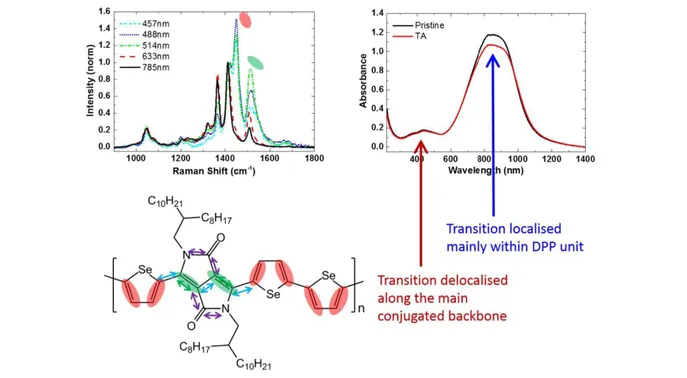
A strong resonant enhancement in the Raman scattering intensity occurs when the energy of the excitation photon matches the energy of a dipole-allowed electronic transition of the molecule. This enhancement is observed for those Raman-active vibrational normal modes which map onto the geometric distortion of the molecule accompanying the electronic transition. In order to elucidate the natures of the different electronic transitions we can use 457 and 785 nm excitations, which allow us to selectively probe the high and low energy absorption bands.
Formation of Polarons
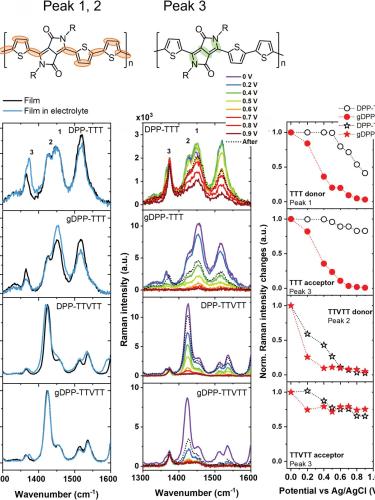
In situ electrochemical Raman spectroscopy allows changes in the molecular structure of organic semiconductor to be monitored during electrochemical doping. Polaron formation is accompanied by reorganisation of the conjugated backbone, resulting in changes in the intensity and position of characteristic Raman-active vibrational modes. By tracking these changes as a function of applied potential, the onset and extent of polaron formation can be probed. Analysis of individual vibrational modes can further reveal which molecular units are involved in accommodating the charge, providing insight into charge localisation and the structural behaviour of the material in its polaronic state.
Photostability
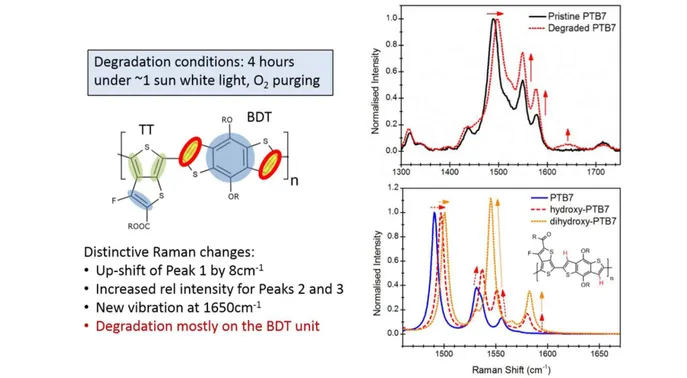
We can probe the effect of photodegradation on the molecular structure of polymer chains in order to understand how different units react with with oxygen and light at molecular level. RBy comparing experimentally observed Raman spectra to theoretical spectra obtained from Density Functional Theory (DFT) simulations of likely degradation products, we identify the nature of photo-oxidised species. This information can assist the development of analogue polymers modified to hinder or avoid that degradation process, potentially allowing the fabrication of high-efficiency long-lifetime OPV devices.